

Integrating Perspectives on Rules

I spend a lot of my time helping people untangle disagreements about rules, and one thing I’ve noticed is that the disagreement is rarely where everyone thinks it is.
People assume they’re fighting about whether a rule is good or bad, fair or unfair. More often they’re standing in completely different places, looking at the same rule, and seeing different things entirely.
That’s not a small point. If you can’t see the different vantage points a rule can be viewed from, you’ll keep having arguments that can’t be won—because the people in them aren’t actually talking about the same thing.
And integrating these differences isn’t necessarily just reconciling differences in interpretation, but often it’s about different fundamental perspectives.
For example, a lawyer, a priest, a game designer, and a meditation teacher would give you four different answers to the question of what a rule is, and they would barely seem to be describing the same thing.
The lawyer points to a codified constraint with a defined scope and an enforcement mechanism.
The priest points to a sacred obligation, an inherited “should” that holds a community together across generations.
The game designer points to a protocol that shapes behavior through incentives and feedback, revised as the system learns.
The meditation teacher points to an inner command arising in awareness—a felt “I must”—something to be noticed rather than automatically obeyed. None of them is wrong.
This is the peculiar thing about rules. The word does not name a single object so much as a whole family of experiences, each one real from where the observer happens to be standing.
Recently I ran the concept through Integral Life’s GigaGlossary, an AI tool built on Ken Wilber’s AQAL framework that shows how the same phenomenon discloses differently depending on the perspective you take on it.
Asked to enact “rules,” it produced a set of views that lined up almost exactly with the four quadrants of experience: interior and exterior, individual and collective.
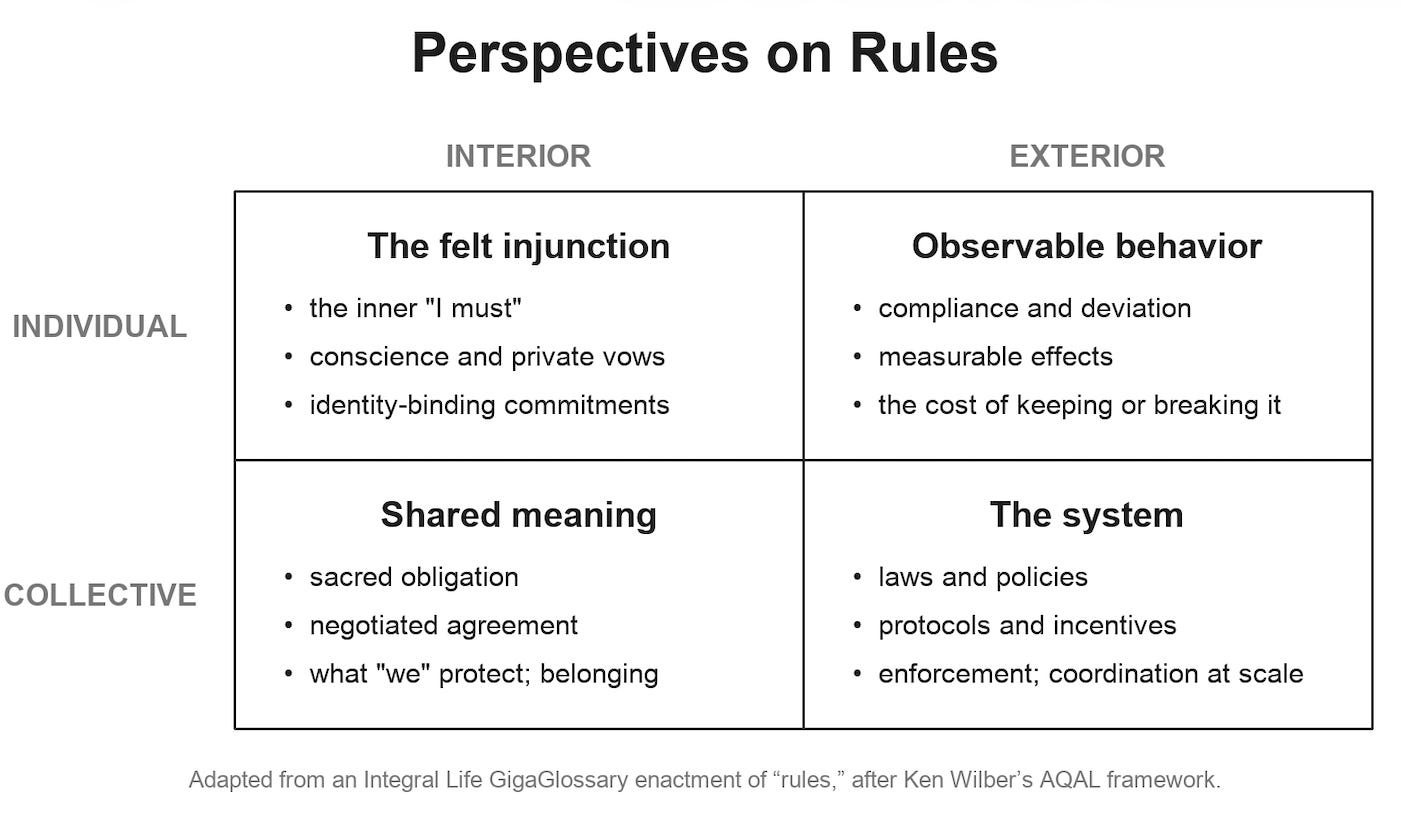
Seen from inside an individual, a rule is a felt injunction—the tightening of conscience, a private vow, an expectation woven into one’s sense of self.
Seen from outside that same individual, it is observable behavior—compliance, deviation, and the measurable effects of keeping or breaking it. Seen from inside a group, it is shared meaning—a sacred obligation, a negotiated agreement, the felt sense of what “we” are protecting when we honor it.
Seen from outside the group, it is a system—laws, policies, protocols, and incentives, the architecture that lets large numbers of people coordinate without ever meeting.
Take something ordinary: a team’s rule that meetings start on time. From inside the individual, it is the small private pressure to stop what you’re doing and show up.
From outside, it is a data point—who arrives when, how often, and what the lateness costs. From inside the group, it is a statement about respect, so that arriving late reads as a slight rather than a scheduling accident. From outside the group, it is a coordination device—calendars, norms, maybe a door that closes at 9:01. One rule, four disclosures, every one of them accurate.
Laying these side by side is genuinely useful, and not only for tidiness. It guards against the most common move in any argument about rules, which is to grab one facet and call it the whole.
Rules are “really” just instruments of power. Rules are “really” just social agreements. Rules are “really” just internalized conditioning.
Each of these takes something true and inflates it into the entire picture, and the arguments that follow are often not about rules at all, but about which quadrant the speakers are standing in. A map of the perspectives dissolves a surprising amount of that noise.
But a map has a limit, and it is the one I keep running into in my own work. Knowing where a rule sits among the perspectives does not tell you the thing you most need to know when you are inside a collaboration: how to work with it.
Two rules can occupy nearly the same location—both written down, both formally legitimate, both endorsed by the group—while one is relied upon without a second thought and the other is routinely ignored.
One earns principled objection; the other, resentful going-along. Perspective alone cannot account for the difference, because it describes where a rule sits, not how it is met by the people living under it.
That gap is the reason my work exists. A map tells you what is where; it does not hand you a compass, or a gauge, or any of the instruments you reach for when you are moving through terrain rather than surveying it from above.
The people doing the collaborating—the ones who have to follow a rule, enforce it, author it, and revise it, often all at once—are not standing outside the map like cartographers. They are inside it, acting under pressure, and they need tools built for navigating rules, not just for describing them.
So integrating the perspectives is the right place to begin, and the quadrants are a good beginning: they make the plurality visible and keep any single view from swallowing the rest. But integration is the setup, not the payoff.
The harder and more useful question is what comes after the map—how a person inside a living system reads a rule, senses whether it actually binds, and decides what to do when it doesn’t. That turns out to be a very different project from mapping, and it’s the one I’m really after.