

The Three Spheres: Information, Relationship, & Collaboration [Reference Article]

Note: A “Reference Article” is more technical or academic. They are also working and evolving documents so while they are intended to be viewed by the public, you may come across half-baked notes, incomplete thoughts or references, and formatting quirks. These imperfections are regrettable, but “getting the information out there” is simply a higher priority than “making it look good.”
Introduction
The Making Rules Matter framework is concerned with collaboration, so it needs some sort of definition for the boundaries of that construct so we know the scope of our inquiry. At first the scope was more intuitive, but in time a model developed that provided a lot more clarity regarding how collaboration is defined, and in particularly, how it is defined in relationship to other related constructs. This model (in lieu of a more compelling name) is “Information, Relationship, & Collaboration Sphere.”
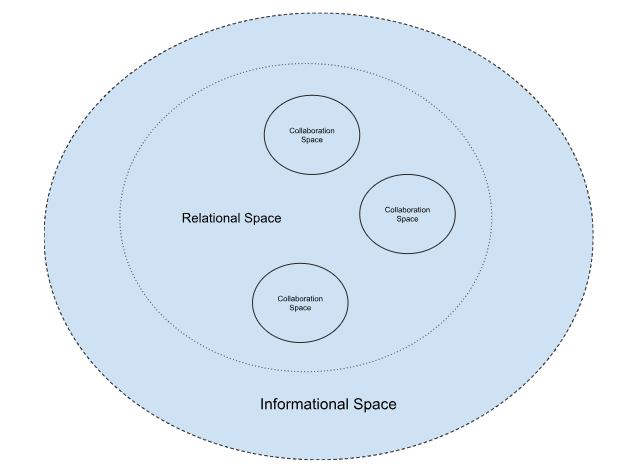
By way of a simple overview, the image above intends to convey the basic relationship between the three spheres in which:
The Information Sphere (or “Informational Space”) is always the broadest and most fundamental. Without information (i.e. connection) there is no possibility of relationship (i.e. information enables potential relationship).
The Relational Sphere or Space enables potential collaboration. Without relationship there is no possibility of the Collaboration Space.
Information always penetrates and permeates throughout relationship and collaboration and relationship always penetrates and permeates throughout collaboration.
Each of these are always just instances and non-permanent. Informational space can emerge or disappear among even the same individuals, just as relationship space can emerge and disappear, and collaboration can emerge and disappear.
This schema is necessary to integrate the all of the needed components needed to understand and predict things like emergent collaboration (that which occurs spontaneously), and many others.
What is Information?
The modern definition of “information” as “whatever makes a difference” has a well-documented intellectual lineage. Gregory Bateson’s famous formulation—“a difference that makes a difference” (Bateson 19721)—is the clearest articulation, but it was itself influenced by earlier cybernetics thinkers such as Norbert Wiener, who defined information as the measure of organization and “the content of what is exchanged with the outer world” (Wiener 19482), and Claude Shannon, who framed information in terms of the reduction of uncertainty (Shannon 1948). Later theorists extended this relational understanding like Yuval Noah Harari who summarizes the cybernetic tradition by treating information as “whatever it is that connects two individual units in a system” (Harari 20143). “Information” then is not just the content of what is communicated, it constitutes the connection itself. Meaning, at the most basic layer of reality, we cannot talk about relationship or collaboration without first establishing (or assuming) there is some kind of information-connection.
To understand this more clearly, take the example of how a single hydrogen ion can shift the pH of a solution: nothing “communicates” in the linguistic sense, yet the presence of that ion makes a difference that changes the behavior of every molecule around it. In biology, a molecule of insulin carries “information” not because of what it says, but because its binding to a cell receptor triggers a cascade of effects—an informational connection between organism-level needs and cell-level action. Even in physics, the spin state of an electron is “information” because its configuration alters the outcomes of quantum interactions. And on the human scale, a raised eyebrow across the room can coordinate behavior just as effectively as a paragraph of text, because it changes another person’s internal state and action possibilities. In all these cases, the common thread is not meaning in the literary sense, but difference: the capacity of one unit to affect another and thereby link them inside a larger system.
Critically, what makes information “valuable” is NOT its veracity. Its accuracy or truthfulness can be an influence, but it cannot be necessary. Think for example of people attending a classical concert who all hear the same music and are united in their experience. How true is the music?
What is the purpose of information then? Well, the purpose is simply to “make a difference” or “provide a connection,” both of which are necessarily vague. When we are talking about pure information, we are dealing with the Information- Sphere and it is necessarily the broadest boundary of this framework’s concern.
What applies or defines the Relational Space?
Field of consideration (i.e. you must consider each other’s messages)
Manners (the implicit identification of a stranger’s status, which is done in lieu of 1) existing formal expectations, and 2) sufficient data about or experience with the person). Example: phatic language/idioms/small talk; signaling status. Manners function in two distinct ways:
Given the phase-shifting of informational, relational, and collaborative networks, manners are loose guides to identify an individual’s status (i.e. primordial order) that an agent uses to help them navigate.
Within existing relationships, manners function as a form of implicit, baseline expectations that agents use to determine the status of that relationship. It is this type that shifts into explicitness with greater diversity.
“Relational Responsibility” (i.e. you are obligated to help those who are helping you). Here is a link to an article describing that construct.
Purpose: Can vary, but it is essentially something about preserving the individuals in the relationship (and usually likely preserving the relationship).
Relational Messages or Indicators are defined as, “A message that indicates an availability for further interaction.” -M. Porcelli.
What applies or defines the Collaboration Space?
Confirmation of a shared purpose. This does not need to be made explicit or verbalized, but some kind of confirmation is needed (e.g. two people nodding across a room to take joint action).
A felt sense of shared purpose (but not necessarily equal purpose).
A sense that one cannot or should not complete some kind of journey or endeavor or enterprise alone.
A sense that beyond just doing something together, there is a being together.
I think within the collaboration space there are also the collected expectations, authorities, and restrictions. (i.e. it is the distinction between role and soul, or relationship and role-lationship).
Purpose: Whatever it is. But remember, though the purpose of a collaborative effort may be a very specific outcome, it will always necessarily include whatever the relational purpose is, and whatever the informational purpose is that enables the collaboration to occur.
What Does This Mean?
Information enables potential relationship. Without information there is no possibility of relationship.
Relationship enables potential collaboration. Without relationship there is no possibility of collaboration.
Each of these are always just instances and non-permanent. Informational space can emerge or disappear among even the same individuals, just as relationship space can emerge and disappear, and collaboration can emerge and disappear.
Just because the Informational Space is more fundamental, it is still impacted by Relational and Collaboration Spaces, just as the relational space is backwards impacted by the Collaboration space; “Work makes companionship.” -Goethe
Information always penetrates and permeates throughout relationship and collaboration; i.e. information is to collaboration what standing is to running.
Relationship always penetrates and permeates throughout collaboration.
In some cases, relationship may almost completely overlap with collaboration, making them seem the same, but relationship is always prior. Think of a contracting relationship, or new team mates meeting each other for the first time on the field. In these cases, it seems as if the connection essentially starts in the Collaboration Space, but that is just how it appears.
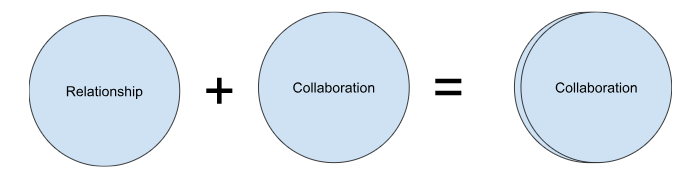
Information --> Relationship --> Collaboration. Note:
Implicit/Explicit: None of these needs to be explicit or formal, but any of them can become defined or labeled explicitly or formally in words. The point is, the implicit/explicit is a separate vector as shown in this diagram:
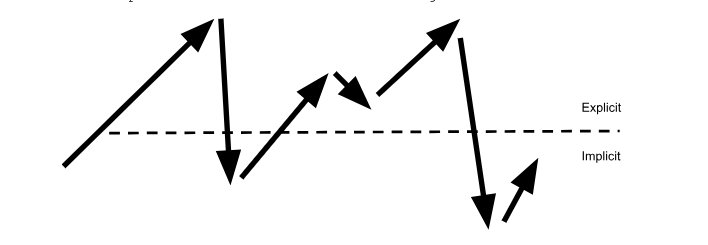
There are two other important vectors:
Intentional/Spontaneous: Any of these can be intentional and planned, or they could be spontaneous and emergent.
Temporary/Ongoing: Any of these can be one-time or temporary, or it could be stable and long-lasting.
Working questions about this:
What about the layers of trust relative to these spheres?
What are the factors that make information “valuable”? A few possibilities:
The nodes/agents like the “change” the information provided to them (through either attenuating or constraining feedback). This explains a lot, but can’t explain everything because there have to be some systemic factors that also prefer or restrict certain kinds of information (Vervanke’s relevance realization?).
I think we need to look at the three different relationships:
Information and relationship
Information and collaboration
Relationship and collaboration
Each of these is a rich area.
Implications for collaboration design. You need to enable the informational network according to the needs of the relationships and the collaboration. And you need to enable the relational network to serve the collaboration. Imagine for example people on a zoom call and they just keep talking over each other. They literally cannot hear what each other is saying. Ashley just got home and shared that she left her work phone at work so it’s relaxing because she can’t even check it. Meaning, removing the possibility of consideration.
Understanding Society/Governments: Add to my model of information, relationship, collaboration that governments are more a type of relationship than they are a type of collaboration. Any relationship will be impacted by its patterns of collaborative occasions, and with government, these collaborative occasions are of a particular unique quality as the nature of the societal relationship is unique.
Tensions Between Relationship & Collaboration
In most collaborative environments, there is a persistent tension between prioritizing relationships and serving the shared purpose.
The relationship-collaboration distinction is essentially synonymous with the culture-structure distinction.
People tend to default to protecting relationships over pursuing the purpose, which can make sense initially—relationships are the infrastructure through which goals are achieved. See my substack article on this topic.
However, this tendency becomes a pattern that rarely self-corrects, and over time it erodes the group’s ability to stay focused on its mission.
This is also the place where I need to work in a response/integration to stuff like Max Schupbach’s work in Deep Democracy Institute, and with Process Work, which emphasizes culture to the exclusion of formal structure.
Safety, Delay, and Social Investment
People often avoid difficult or purposeful action (like confronting issues or enforcing standards) to preserve relational harmony.
This is partly due to the lack of deeper emotional investment in the collective purpose, especially when the group’s cohesion is based more on social bonds than on a meaningful commitment to a shared goal (e.g., mission, profession, or institutional loyalty).
The Problem with Implicit Agreements
When rules and expectations are informal and implicit, they tend to reinforce personal and relational dynamics instead of organizational integrity.
Resistance to making expectations explicit often stems from a desire to protect relationships from the instrumental influence of collaboration.
But this can contribute to a culture where informal norms dominate, which undermines the possibility of organizational clarity and accountability.
INFORMATION AS STORY, STOCKS, AND STRUCTURE
Fundamentally, SOC/MRM is about understanding how information and power work. Both on the individual level and on the larger collective level. Using the work of Yuval Harari in “Nexus,” I like the notion that information is a form of connection and that connection doesn’t necessarily equate to truth and in fact, in some ways information can be connecting precisely because it is NOT truth. I can pull more from the book, but I want to build on the point about connection as a baseline, and then within “connection” you can operationalize connection in service of a particular goal or outcome and the intention or actualization of that is what we call, “collaboration.”
I think the key distinction between just sharing “information,” and wanting to actually expect something can be identified with the question, “Would you care if the recipient does anything with this information?” Or, “Is it OK for the recipient to listen to this information and then decide to ignore it?” If so, then it is just information, or context, but if the author wants to expect that the agent DOES something with the information, then we are getting into the realm of prescriptive expectations (i.e. structures). Remember, this is distinct from a descriptive expectation which could be something like, “Well, they can ignore it if they want to, but I don’t think they will.”
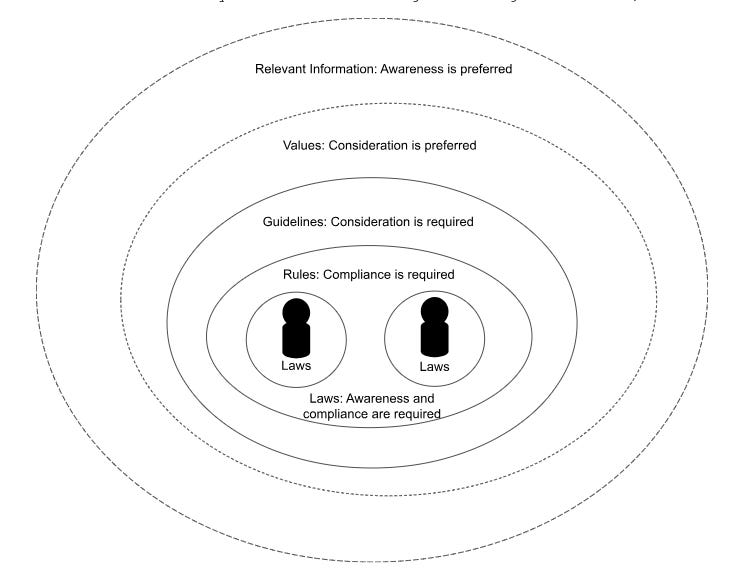
“Structure Standards/Scope”: This is a way to understand how the different structures relate to each other in some sort of hierarchy. Clearly, a hierarchy of severity doesn’t work. And yet, there does seem to be some order or sequence to them. This is one way to represent it though I’m not 100% convinced this is right, it seems like a good start.
Relevant Information: [outermost circle] Awareness is preferred. This category was previously missing altogether, but I think the introduction of the idea of “Stocks” or basically how do I integrate the functions of checklists and metrics into the equation. This also acknowledges the fluidity of how the organization completely sits in and is completely interpenetrated by information.
Value: Consideration is preferred. This idea isn’t itself new to this model, but the phrasing is useful for showing how this type of structure relates to the other types of structures. The fact that consideration is preferred also may explain why Values even come up in the conversation of structures since they are technically not binding, but certainly seem binding.
-------BINDINGNESS THRESHOLD-------
Guideline: Consideration is required. I don’t think it’s really necessary to re-explain this.
Rule: Compliance is required. This is also self-explanatory by this point.
Law: Awareness and Compliance are required. This is where things get interesting again, because I’ve been trying to figure out how to understand the relationship between Values and Laws, but in a counter-intuitive way, because what unites them is the need for self-reflection and self-awareness. In the case of Laws, awareness is needed to effectively operationalize it though we could say that one’s awareness may not need to be conscious, as in a case in which someone just knows (in the body) a boundary was broken though they may not know why. If it were outside their awareness completely, according to how I’m defining it, then it would be a very, very, very poor Law.
This model introduces a few new constructs:
PREFERENCE: Unlike consideration or compliance, preference is a form of structure that is not binding, but nonetheless relevant. And in fact maybe it is more significant in the definition of Values that I first realized when I drafted this diagram.
AWARENESS: This seems to be needed, but may be getting too nuanced. Awareness is just the prerequisite to everything else and it also contains within it a small version of “consideration.” This is important because it helps explain the mechanisms and motivations for why we even share information with each other. If I share it with you, then you are aware of it, and that DOES something.
I also like this model of “Structure Standards/Scope” because it helped me resolve how to connect Values and Laws. The challenge was that Laws, as I use the term, are defined as deal-breakers and Values are defined as meaningful aspects of identity, yet are these two things not related? Doesn’t our identity shape our boundaries? From the interactive perspective, it is likely more the case that boundaries are sensed through one’s Values, though that misses something as well. Anyways, here are some of the solutions that this diagram provides:
They both share the same approach to Exploring, which is self-reflection. In the case of Values, to the degree that they need to be defined, they are about self-awareness and their function is to provide some meaning and coherence to one’s own self-understanding. This then can be used to communicate to others, and/or it could be used to consider what, if any, structures or practices might be helpful to address any of one’s weak points. In the case of Laws, the self-reflection is to identify any relevant boundaries or terms that must be honored.
In both cases of Values and Laws, it is optional what the agent may DO with that information. It should not be concluded in either case that the awareness one gains must necessarily be captured or operationalized in any particular way.
“Stocks” are a type of relevant information that essentially equates to Harari’s “Lists” from Nexus in which he contrasts different types of connecting information: 1) “Mythology”/”Stories” from 2) “Bureaucracy”/”lists.” (though I don’t know if he really intended for just these two categories to be comprehensive). Of course I use the term “structure” to cover a lot of the bureaucratic side of things, but lists are also not equal to structures (e.g. metrics, checklists, inventory, money, etc.) because these are not themselves expectations, but descriptions. However, if a metric is used as a “target” then it becomes a prescriptive expectation and therefore a structure.
Money is a form of information and a particularly important “stock” when it comes to collaboration. That information of course is about how much something is worth. We don’t necessarily need to get into the complicated and nuanced details of economics to understand that money is one of the most important forms of collaborative information there is, and I’m sure I’ll need to cover it in some depth when the time is right.
Bateson, Gregory. Steps to an Ecology of Mind. 1972.
Wiener, Norbert. Cybernetics: Or Control and Communication in the Animal and the Machine. 1948.
Harari, Yuval Noah. Sapiens: A Brief History of Humankind. 2014.