

Worshiping We: Debunking Six Myths of the Collective Individual

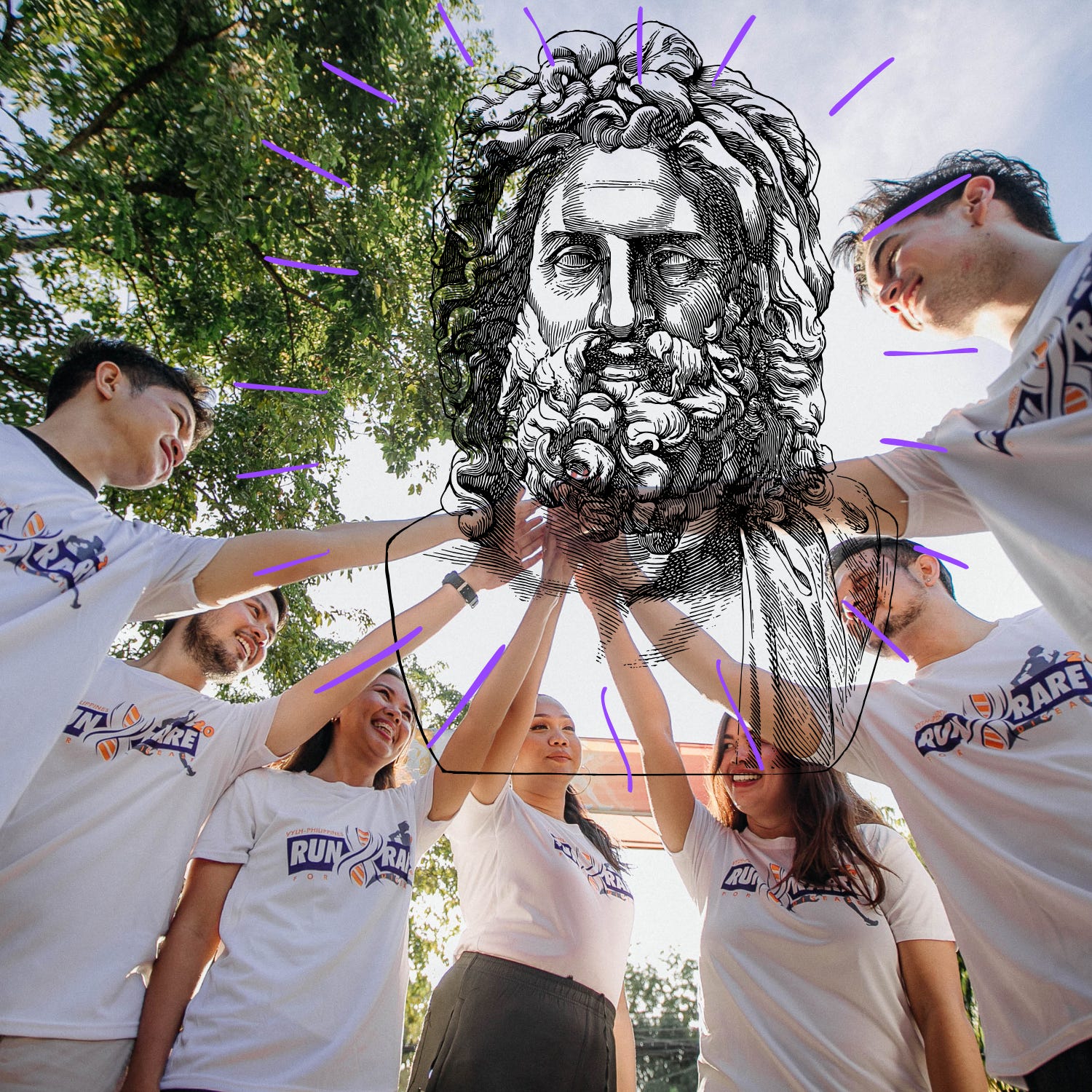
Ancient peoples believed in gods for everything. Not just gods of wind and earth, but gods of travel, of love, of the harvest, of the home.
When things went wrong, someone was behind it. The crops failed because someone failed to appease Demeter. The ship sank because Poseidon was angry. To fix it, figure out what the god wants, and try to convince it to change its ways.
Today most people would dismiss those beliefs—and the rituals that accompanied them—as naive, or at least pre-scientific. We understand that weather doesn’t have an agenda. The ocean does not literally have a mood.
And yet almost all of us believe in a different kind of animism. Let’s call it the god of the group.
“The team learned from that mistake.” “The company is concerned that…” “The organization is committed to change.”
We say these things in board meetings and retrospectives and they sound perfectly reasonable. And they ARE in the same way we might say, metaphorically, that the weather was “bad,” or the traffic was “unforgiving.”
We know what these phrases mean. But there comes a point when we lose touch with the rhetorical nature of such things.
The Myth of the Collective Individual
I’ve written before about what I call the regime—the projected personal identity we assign to a group so we can relate to it as a coherent actor. That projection is often useful.
It gives the collective a solidity it lacks in reality, the way we distance ourselves from the probability of failure or death in order to get through the day. For most people, most days, it’s a useful fiction. It really is.
But it becomes a problem—sometimes a serious one—when the people designing, leading, or governing organizations mistake the fiction for the reality. When you assume a group develops, remembers, learns, wants, and commits the way a person does, you build structures that fail in predictable ways.
1. The Myth of Persistence
Train the group once and it stays trained; what it learned, it remembers; what it could do, it can still do.
Groups don’t retain learning, memory, or capacity the way individuals do. Newcomers arrive, norms drift, knowledge holders leave—and the lesson learned last year walks out the door with them. Capacity isn’t a stable attribute either; it depends on who’s in the room.
What to do instead: Treat learning as maintenance. Externalize memory in decision logs and documented rationale, build onboarding loops, cross-train, and ask regularly—if these three people left tomorrow, could we still do this?
2. The Myth of One Mind
The group has an intention and is committed to it.
A collective is a swarm of incompatible interpretations and divergent incentives. The founder wants market share, the manager wants stability, the new hire wants experience—and what looks like alignment is often temporary compliance. “The group is committed” masks a distribution of commitments, some strong and some paper-thin, that breaks the moment real pressure arrives.
What to do instead: Design for divergent motivations rather than assuming shared ones. Don’t ask how to make everyone want the same thing; ask how people who want different things can still coordinate. And make individual commitment visible—find out who will actually carry the decision.
3. The Myth of Uniformity
The group has one identity, one understanding, one consistent way of behaving.
Identity isn’t simply stored inside people, but reconstructed in every interaction. Understanding isn’t shared either—you get islands of meaning: the person who wrote the memo, the one who skimmed it, the one who heard about it secondhand. And behavior isn’t coherent across contexts. Engineering and sales share a logo but inhabit different realities.
What to do instead: Assume misunderstanding as the default and build checkpoints that surface divergence early. Invest in the rituals and shared language that reconstruct identity. Design for local coherence with explicit interfaces between contexts—don’t assume everyone cares about the same things for the same reasons.
4. The Myth of Shared Responsibility
When the group is responsible, the group will handle it.
Responsibility diffuses and vanishes. Design that assumes a collective agent will notice, decide, and act is design that guarantees no individual feels ownership. “We’re all responsible” is functionally identical to “no one is responsible”—one of the most reliable ways to produce organizational failure, because the thing everyone owns is the thing no one does.
What to do instead: Assign responsibility to individuals, not groups. If a decision matters, someone specific needs to own it—by name. A collective can hold a value, but only a person can be held to account for acting on it.
5. The Myth of Parallel Attention
The group can prioritize many things at once.
Only individuals attend. Collectives bottleneck through limited channels of communication, so treating the group as a multi-threaded processor produces coordination failure: too many initiatives, not enough bandwidth, everything half-attended. The group’s attention is narrower than you think—narrower than the sum of its members, because most of their attention is spent elsewhere.
What to do instead: Respect the group’s actual bandwidth. Prioritize ruthlessly, and sequence rather than parallelize when communication channels are limited. Fewer things attended fully will move further than many things attended halfway.
6. The Myth of Silent Alignment
If no one objects, then everyone agrees.
This mistakes quietness for agreement. People stay silent for dozens of reasons—confusion, disengagement, fear, indifference, calculation—and none of them are agreement. The decision that sails through unopposed is often the one no one understood well enough to question, or cared enough to fight.
What to do instead: Design decision processes that actively surface dissent rather than assuming its absence means alignment. Ask the quiet people directly. Silence is data, but it isn’t consent.
Conclusion
The old gods were useful stories. The new ones are too. But we shouldn’t mistake the story for the structure.
The Romans believed every person had a genius—a personal spirit. But they applied the same concept to the state itself: the Genius Populi Romani, the spirit of the Roman people, a real agent that could be appeased or offended. When things went badly, citizens would make ritual offerings to it. Literally.
We may think we’ve outgrown this, but we’ve just stopped saying genius and started saying “we.” Different words, same grammar. Same imagined agent. Same appeal to a god that isn’t really there.
I’m not even saying we should stop thinking this way. Believing is not something we can directly control. And even if we could change it, I'm not sure we should.
After all, I don’t mind if the pilot thinks Zeus is causing the turbulence, but I do want them to take responsibility for getting us through it.
Yes, all of that too. Different articles though. :)
What about the myth that there is such a thing as individual behavior? Or is the illusion/myth of me trumping the illusion /myth of we?